
|
Quantity
|
Out of stock
|
||
|
|
|||
|
|
|||
The family came out in pairs of denominations: 50 and 100 reais in 2010, 10 and 20 in 2012, 2 and 5 in 2013; this denomination appeared in 2013. The first family lost none of its force: the bank says those notes remain valid and will be replaced little by little as they wear out, and that the two families will circulate together for an indefinite period. The sizes within the family are deliberately staggered: the higher the denomination, the longer the note, while there are only two heights — one for the 50 and 100 reais, another for the remaining four values. The bank explains this by accessibility for the blind: differing lengths give a reliable way of telling the notes apart by touch, and raised bars are printed in the lower right corner for the same purpose.
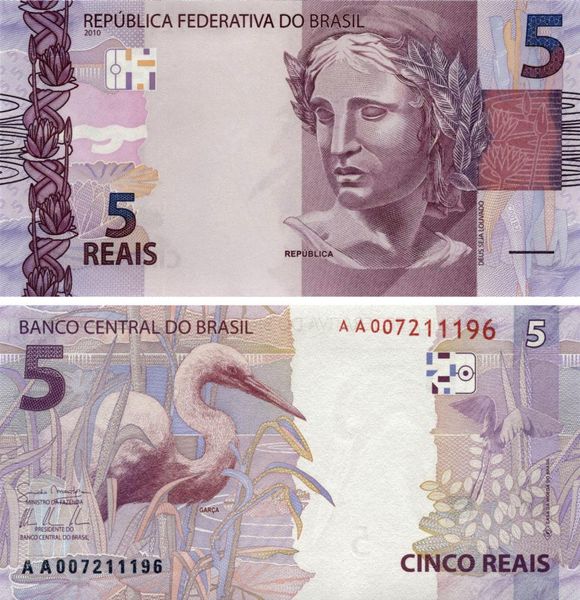
The face carries the allegorical effigy of the Republic — the theme of the face is the same across the whole family. The legend República Federativa do Brasil runs on the front, and to the right of the effigy stand the words Deus seja louvado. Two signatures are printed here as well, called chancelas in Brazil — those of the Minister of Finance and of the President of the Central Bank; they change whenever either office changes hands. The back of the family is given over to Brazilian wildlife: this denomination carries the heron. The legend Banco Central do Brasil stands here too, and the serial number is printed twice: in blue at the lower left and in red, in digits of increasing size, at the upper right. Each note's number is unique, and it is what identifies the note.
A note of the second family of Real banknotes issued by the Central Bank of Brazil. The most interesting security features are a watermark, visible only against the light — the image of the heron and the numeral of the value. The bank stresses that it is made while the paper is being manufactured, not printed onto it; this denomination has no security thread — the bank states outright that the thread is present only on the 10, 20, 50 and 100 reais; and a see-through register, the «puzzle» — parts of it are printed on both the face and the back, and against the light they join into the numeral of the value.
The second family of the Real is a case where the security of the note and the convenience of a blind user are solved by the same device: the length of the sheet. For a collection it makes an even, recognisable run in which every denomination keeps its own animal. UNC condition means the note has never circulated: no folds, no wear, no soiling, even corners — just as it left the press.
A collection can grow in any direction, and the VPcoins catalogue has options for each of them.